
 Part of the Kilwaughter Group

The Vital Role of Earthworms in Building Healthy, Sustainable Soils
Healthy soils are the cornerstone of productive agriculture, and few organisms contribute more to soil health than earthworms. Earthworms play a vital role in maintaining soil structure, enhancing nutrient availability, and supporting biodiversity. In the UK and Ireland, where grassland and arable farming dominate, understanding the link between earthworm activity and soil management practices is essential for sustainable farming practices.
Why Earthworms Matter
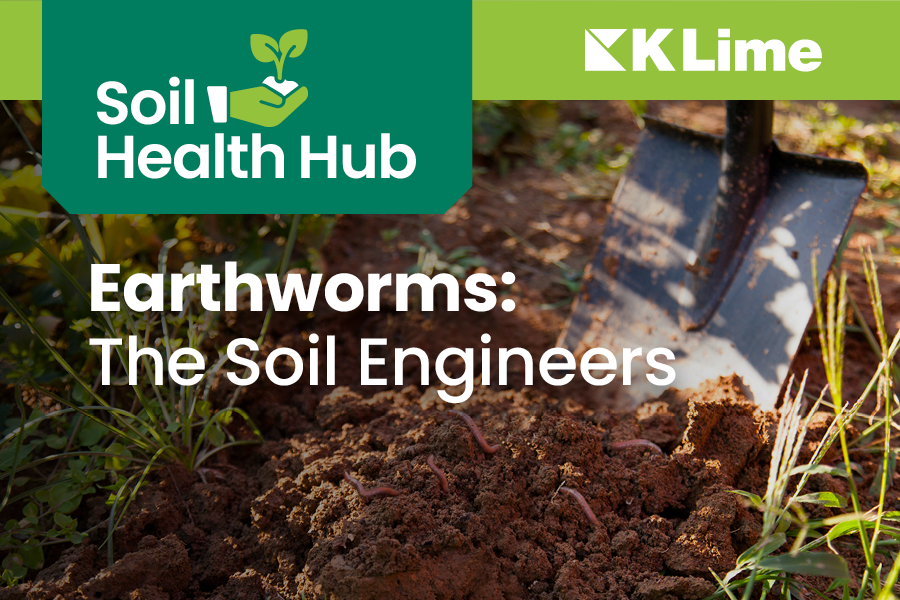
Earthworms improve soil through a combination of physical, chemical, and biological processes. Their burrowing creates networks of channels that aerate the soil, improve drainage, and reduce compaction. These tunnels allow plant roots to penetrate deeper and access water and nutrients more efficiently. Earthworm “excreta” (mucus and urine) are rich in essential nutrients such as nitrogen, phosphorus, potassium, and calcium, making them a natural Fertiliser that enhances soil fertility.
Earthworms also contribute to soil health in ways that are less visible but equally important. Their activity helps increase soil organic matter, which strengthens the soil’s structure and improves its resilience to erosion. In the process, they stimulate diverse microbial communities that break down organic materials more efficiently, releasing nutrients that plants can readily use. This relationship between earthworms and soil microbes plays a central role in maintaining healthy nutrient cycles within agricultural soils, ultimately supporting stronger and more productive ecosystems.
Earthworms and Soil pH: A Critical Connection
Soil pH is one of the most influential factors on earthworm populations. Earthworms thrive in soils with a near-neutral pH, where microbial activity and nutrient availability are optimal. Acidic soils significantly reduce earthworm density and diversity due to calcium deficiency and aluminium toxicity, which impair their metabolism and reproduction.
This is particularly relevant in the UK and Ireland, where high rainfall and nitrogen fertiliser use contribute to soil acidification. Studies indicate that almost 80% of grassland soils across Great Britain and Ireland fall below the optimal pH range, limiting earthworm activity and ultimately nutrient availability.
Liming: A Win-Win for Soil and Earthworms
Liming is one of the most cost-effective soil management practices. By raising soil pH to the optimal range (typically 6.2–6.5 for mineral soils and 5.3–5.8 for peaty soils), lime improves nutrient availability, reduces the risk of toxic elements, and enhances the efficiency of applied fertilisers.
Acidity is a major obstacle for a thriving Earthworm Population in your soil, therefore Liming is crucial to helping promote earthworm activity. Studies in upland grasslands have demonstrated that earthworm populations are markedly higher in limed soils compared to unlimed soils, with acid-intolerant species such as Allolobophora chlorotica thriving only where pH has been corrected.
Calcium: More Than Just a Nutrient
Calcium, supplied primarily through lime (calcium carbonate), is essential for plant growth and soil health. It stabilises soil structure by promoting aggregation and reducing compaction. For earthworms, calcium is critical for cocoon production and overall physiological function. Acidic soils often lack sufficient calcium, creating a hostile environment for earthworms and other beneficial organisms. Liming not only corrects soil acidity but also replenishes calcium reserves, supporting a thriving soil ecosystem (read more on the importance of Calcium in our blog here )
The Bigger Picture: Soil Health and Sustainability
Earthworm populations in the UK have declined over the past 25 years, largely due to intensive farming practices, soil acidification, and habitat loss. This decline threatens soil health and ecosystem services, making interventions such as liming even more critical. By maintaining optimal pH and calcium levels, farmers can create conditions that sustain earthworm populations, improve nutrient cycling, and enhance soil resilience against climate-related stresses.
Conclusion
Earthworms are indispensable allies in sustainable agriculture, silently working to improve soil structure, fertility, and biodiversity. Their well-being is closely tied to soil pH and calcium availability - factors that farmers can control through liming. In the UK and Ireland, where soil acidification is widespread, adopting a strategic liming programme is not just good practice; it is essential for sustainable farming. By investing in lime, farmers invest in the health of their soils, the productivity of their crops, and the resilience of their ecosystems.