
 Part of the Kilwaughter Group

How Can You Maximise Your Soil if You Don’t Know What’s In It & How It’s Working - CeC

In the previous article, we focused on the power of pH and the difference between the active and buffer pH measured on a Gold soil analysis. You can find the first article HERE.
Next, we start to explore how pH and cation exchange capacity drive nutrient availability within the soil.
Important influences on your soil pH include soil type, parent material, soil structure, organic matter and cation exchange capacity. There is little you can change about your soil type and parent material – think of it as a hand of cards you’ve been dealt. However, you can influence your soil structure, organic matter and to some extent your cation exchange capacity.
Cation exchange capacity (CEC) is the number of exchange sites within your soil to hold positively charged ions, known as cations (such as Calcium, Potassium, Magnesium and Hydrogen). Soils with a high CEC have larger nutrient retention capacities.
The size of a soil’s CEC is determined primarily by its clay and organic matter content – as this increases, so does the exchange capacity. This is because clay colloids and humus (the stable portion of organic matter) are negatively charged. The more clay and humus, the more binding sites there are for cations - remember, opposites attract.
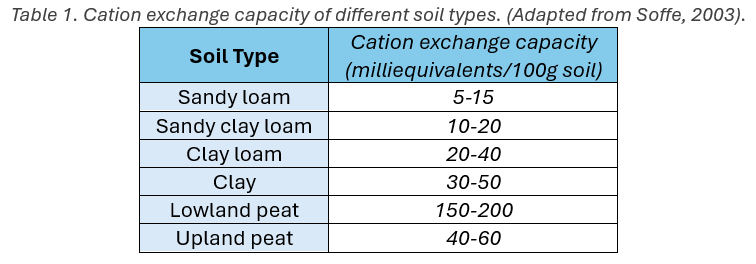
There is a magnitude of difference between soil types, with a clay soil being able to hold up to four times as many cations as a sandy soil (Table 1). Soils with high organic matter content like peat soils have even larger exchange capacities, highlighting how organic matter content plays a key role in CEC!
Bringing this back to pH, knowing the CEC of your soil helps you understand how it responds to acidity and alkalinity. A soil with a low CEC can go acidic more rapidly, as there are fewer binding sites to be filled up by H+ ions. In contrast, a high clay and organic matter content soil will acidify more slowly but will require a higher quantity of lime to correct its pH if needed.
Generally, maximum nutrient availability occurs between pH 6-7 (Figure 1). This is because:
- Nutrients, such as Nitrogen, are released when microorganisms break down organic matter. For Nitrogen, this process is known as mineralisation and occurs at an optimum pH of between pH 6-7.
- Cations such as Potassium are more available as the pH increases. At a low pH the exchange sites are dominated by a high concentration of H+ ions.
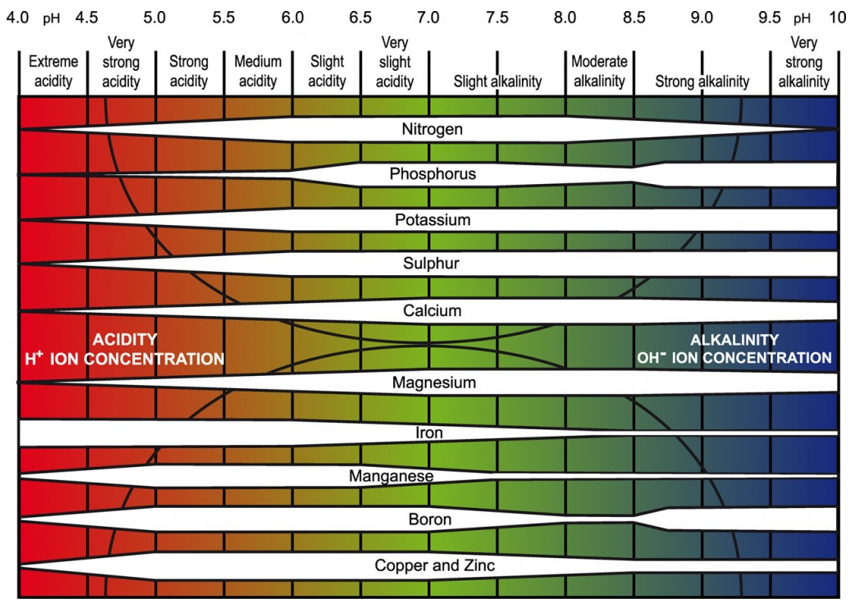
Figure 1. The availability of nutrients along the pH scale is indicated by the width of the white bars. (Image from pda.org.uk).
If the pH becomes acidic, nutrient use efficiency is affected with the potential to cause both financial and environmental losses. Important cations such as Potassium (K+), Calcium (Ca2+) and Magnesium (Mg2+) become pushed out by H+ ions. Additionally, a low pH increases the presence of heavy metals such as Aluminium (Al3+) and Iron (Fe3+) which form strong complexes to Phosphorus, locking it away from the plant.
Measuring the soil’s CEC, pH, soil texture and organic matter enables us to understand how it will behave, respond to inputs and what nutrients are available or unavailable to the plant. By utilising these measurements on a Gold analysis, you can baseline where you soils currently are and what changes can be made to improve them.
The unique benefit of the Gold soil analysis is that through interpretation with a Soils Specialist, you can understand the root cause of any physical, chemical or biological imbalances. As a result, this promotes informed management actions to make a change rather than repeatedly treating symptoms. It puts your soil on one sheet of paper and by understanding each parameter, and how it interacts, you can look to boost soil health and functionality.