
 Part of the Kilwaughter Group

Are You Maximising Your Soil Potential?
Soil health is underpinned by a whole heap of physical, chemical and biological properties. It is these factors and their interactions which makes soils so complex, but also so exciting! Unless we understand what we are working with, we cannot make the most informed decisions. This is the first in a new series of monthly articles to help you unpick the interactions between the physical, chemical and biological properties of your soils to support decision making on farm.

This is the first in a new series of monthly guest blogs from Hutchinson's Healthy Soils to help you unpick the interactions between the physical, chemical and biological properties of your soils to support decision making on farm.
All the measurements discussed are present in a Gold soil analysis, which Kilwaughter Lime can provide in Partnership with Hutchinsons. This analytical package extends beyond the scope of the standard soil test, providing a more comprehensive characterisation of soil chemical, physical, and biological properties for those seeking a higher-resolution assessment.
This in-depth level of analysis will allow you to understand the key parameters that inform a soil’s functionality. The Gold soil analysis contains over 30 different parameters measured in a lab. It allows your soil to be baselined and limiting factors determined, to inform management decisions.
For a comparison between the standard Soil test and Gold analysis, including the parameters measured and their applications, please refer to the following blog
The first step is to explore the true power of hydrogen: pH.
pH is a key player in a soil’s chemical, physical and biological balance. This in turn impacts plant growth and development. Understanding where your soil sits on the pH scale, and how close that is to your optimum, is critical for productivity.
pH stands for ‘Power of Hydrogen’. It is a measure of hydrogen (H+) ions and reflects a soil’s chemical balance (Figure 1).
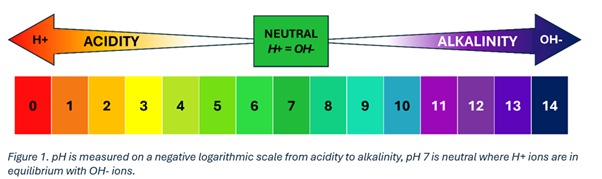
pH acts along a negative logarithmic scale from 0-14, put simply: as pH decreases, acidity increases (e.g. pH 5 is 10x more acidic than pH 6, and 100x times more acidic than pH 7).
For optimum performance, a soil’s chemical environment tends to be balanced between pH 6 and pH 7 on mineral soils. Remember that a lot of plant nutrition comes from microbial-plant interactions, so chemically balanced soils with good physical structure will help biology (roots and microbes) thrive.
When using a lab to analyse your soil’s pH, there are two measurements to look for: the active pH and the buffer pH. Both are included on a Gold soil analysis.
Active pH | Buffer pH |
Also known as the water pH, can fluctuate throughout a season. This can change due to factors such as rainfall events, fertiliser applications, droughts, cultivations or changes to soil structure. | Is a measure of your soil’s capacity to buffer against pH changes. It is the level of reserve acidity/alkalinity of the soil and can be referred to as the soil’s ‘resting heart rate’. |
Important influences on your soil pH include soil type, parent material, soil structure, organic matter and cation exchange capacity. While some factors, such as soil type, are not easily changed, others are impacts of the environment or management practices. Soil type is like a playing card you’ve been dealt in a hand, there is little you can do to alter the sand, silt and clay percentages of your fields. However, knowing what you have to work with helps inform decisions regarding pH management, nutrient applications and maximising productivity.
By measuring both the active and buffer pH, it presents the opportunity to understand how a soil is performing. If the two pH values sit far apart, it indicates that there is a chemical imbalance. Correct interpretation of the 30+ parameters of the Gold analysis helps build a picture of the cause of this divergence. Every Gold analysis comes with a 30-minute video call to interpret your results with a Soils Specialist from the Healthy Soils team at Hutchinsons.
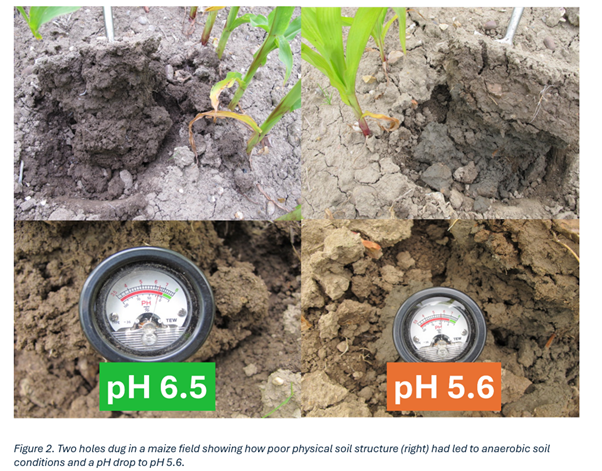
Some common causes for a difference between active and buffer pH readings include (but are in no way limited to) compaction, overcultivation, waterlogging, low soil biology, over/under-application of fertilisers. For example, a compacted soil with poor physical structure creates an anaerobic environment for biology, this results in an increase in acidity and drop in pH (Figure 2).
The unique benefit of the Gold soil analysis is that through interpretation with a Soils Specialist, you can understand the root cause of any physical, chemical or biological imbalances. As a result, this promotes informed management actions to make a change rather than repeatedly treating symptoms. It puts your soil on one sheet of paper and by understanding each parameter, and how it interacts, you can look to boost soil health and functionality.
In the next article, we will look at the impact of pH on nutrient availability. Where your active and buffer pH sits along the pH scale determines which nutrients may be in excess and which may be inaccessible. Other important factors include soil type, bulk density, organic matter and cation exchange capacity.
If you have already had your soil tested and want some free advice on what it means and what to do next visit Soil Health Hub and upload your results.
If you are interested in a more in-depth gold soil analysis Contact Us